Home › Services › Spider Control
Spider Control in Worcester, MA
Spiders in a Worcester home are usually a symptom of something else: the insects they eat. A house with spiders in every corner has insects in its walls, and a house with webs across the porch light has moths and flies gathering there every night. Spider control that only removes webs treats the symptom; the visit also looks at what is drawing the spiders in.
Call Now
Describe what you are seeing and where you are — a local pest control professional is connected from there.
Call NowMon–Fri 7:00 AM–10:00 PM ET · Sat 8:00 AM–10:00 PM ET · Sun 7:00 AM–9:00 PM ET
How spider control works in Worcester homes
House spiders build webs in corners, behind furniture, in basements and attics — anywhere undisturbed with a steady supply of small insects. Cellar spiders, the long-legged ones that hang upside down in basement corners, are common in Worcester's older basements. Their webs are messy and persistent, and they rebuild fast if the insects keep coming.
Wolf spiders do not build webs. They hunt on the ground, and in fall they wander indoors through gaps at the foundation and under doors, looking for warmth. A large spider on the basement floor in October is usually a wolf spider that came in through a gap, not a nest in the house. Sealing the gap matters more than spraying the floor.
Spiders follow prey, and prey follows light, moisture and food. Porch lights draw moths, which draw spiders to the eaves. Damp basements draw silverfish and other small insects, which draw cellar spiders. A kitchen with pantry pests will have spiders in the corners above it. The visit reads the spider pattern as a map of the insect pattern underneath.
- Webs and egg sacs removed from corners, eaves and basements
- Harborage areas identified — clutter, storage, undisturbed corners
- Insect prey sources checked — lights, moisture, pantry pests
- Entry gaps at the foundation and under doors listed for sealing
- Follow-up visit planned if webs return quickly
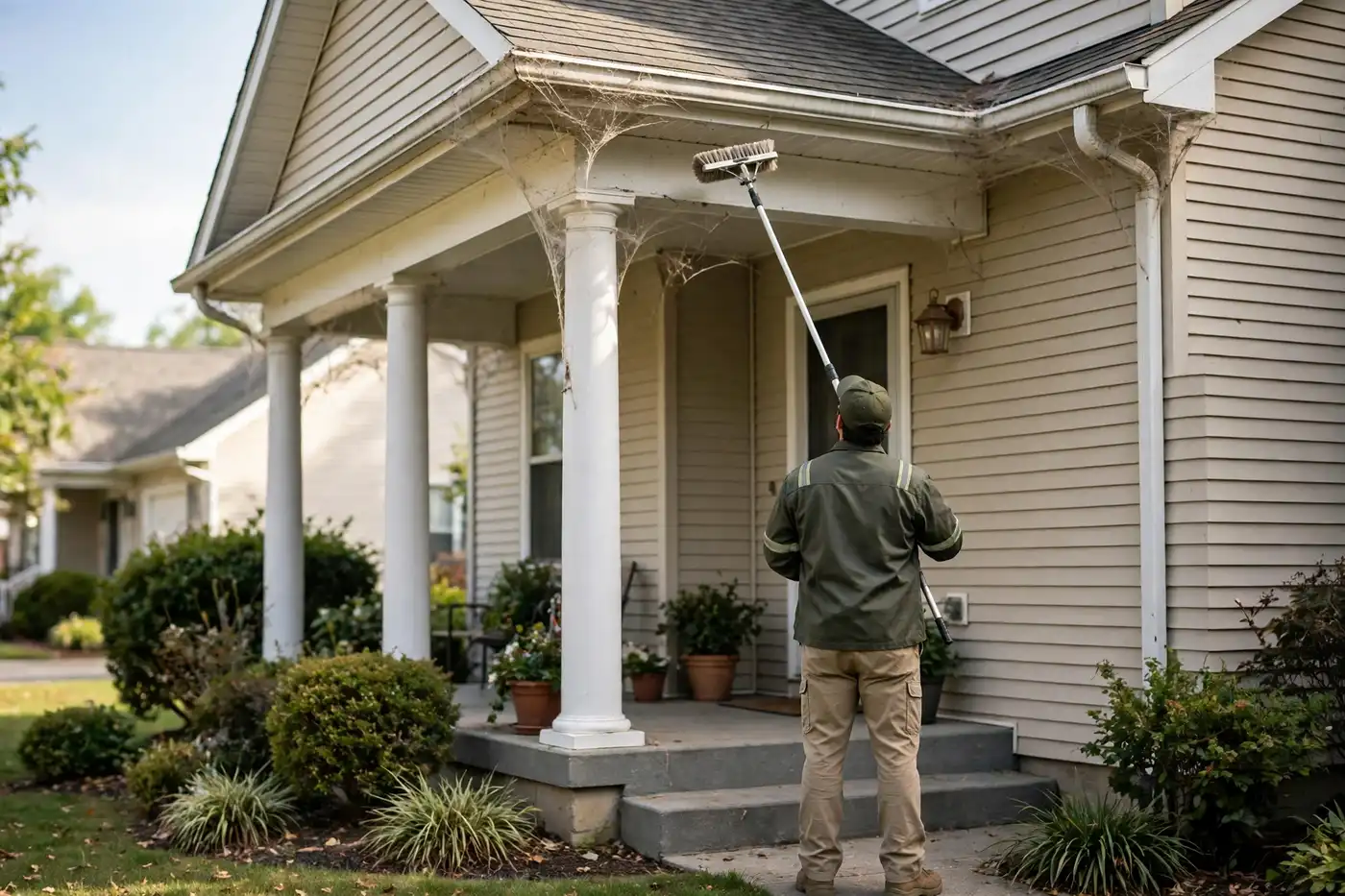
What spider control includes
Web and egg sac removal
Webs and egg sacs are removed from corners, ceilings, eaves, basements and garages — including the sacs, because a single sac can hold dozens of spiderlings.
Harborage treatment
The areas spiders hide in — behind stored boxes, in basement corners, in attic insulation edges, under decks — are treated so spiders do not simply move to the next corner.
Exterior eave and foundation work
The outside of the home is treated where spiders set up: eaves, porch ceilings, window frames and the foundation line, where insects gather and spiders follow.
Prey reduction
The visit checks what the spiders are eating — the moths at the porch light, the insects in the damp basement, the pantry pests in the kitchen — and the plan covers those too.
Entry-point sealing advice
Gaps at the foundation, under doors and around utility lines are listed for sealing. Fall wandering spiders come through gaps, and closing them is the lasting fix.
Follow-up check
Webs that return within weeks mean the prey is still there. The follow-up visit checks whether the webs are back and whether the insect traffic underneath has dropped.
What happens when you call
Describe what you see
On the call, describe the spiders — webs in corners, large spiders on the floor, webs across the porch — and where they appear most. That shapes the visit.
Inspection of the pattern
The visit maps where webs and spiders concentrate, then looks underneath: the lights drawing moths, the damp corner drawing insects, the gaps letting fall spiders in.
Webs and sacs removed
Webs and egg sacs are removed first, so the treatment goes onto clean surfaces and the visit can tell new activity from old.
Treatment placed
Treatment goes into the harborage areas and along the eaves and foundation where spiders set up, placed where spiders hide rather than across open rooms.
Sealing and follow-up
Entry gaps are listed for sealing, and a follow-up visit checks whether the webs stay down and the prey traffic has dropped.
How the work is done
Removal comes before treatment. Webs and egg sacs are cleared from corners, eaves and basements so the treatment reaches the surfaces spiders actually use, and so new webs after the visit are easy to spot. A web left in place hides the result — the homeowner cannot tell whether the treatment worked or the old web is simply still there.
The treatment targets harborage, not open space. Spiders hide in undisturbed places: behind stored boxes, in the corners of a basement, along the top of a garage wall, under a deck. Treatment placed there reaches the spiders; treatment sprayed across a living room floor mostly reaches the floor. The visit spends its time in the corners, not the middle of the room.
Prey control is spider control. A porch light that draws moths all night will draw spiders to the eaves every night. A damp basement with silverfish will hold cellar spiders. The plan covers the insects underneath — the light placement, the moisture, the pantry check — because spiders follow food, and food is the lever that lasts.
Before the visit
Clear access to baseboards and the rooms with activity, pick up pet bowls and toys, and note where you have seen activity — the inspection follows your evidence.
Problem → solution
Problem
Webs rebuild across the porch ceiling every week, and large spiders appear on the basement floor each fall. The corners behind stored boxes are thick with old webs.
Solution
The visit clears the webs and sacs, treats the eaves and the basement harborage, and lists the foundation gaps the fall spiders use. The porch light is moved off the door, the basement is dried — and the webs stop coming back.
Problems spider control solves in Worcester
Webs in every corner
Webs that rebuild within days mean the prey is still there. The visit removes the webs and checks the insects underneath — the light, the moisture, the pantry — rather than treating the web alone.
Large spiders on the floor in fall
Large hunting spiders on the basement floor in autumn usually wandered in through foundation gaps looking for warmth. The visit seals the route, not just the spider.
Cellar spiders in the basement
Long-legged cellar spiders in basement corners point to a damp basement with small insects to eat. The visit checks the moisture and the insect traffic, not only the spiders.
Spiders on the porch and eaves
Spiders at the porch light are eating the moths the light draws. Moving the light, changing the bulb, and treating the eaves together do more than any one of them alone.
Other pest services in Worcester
Inspection-led ant control for Worcester homes and businesses.
Inspection-led termite control for Worcester homes and businesses.
Inspection-led cockroach control for Worcester homes and businesses.
Inspection-led mosquito control for Worcester homes and businesses.
Inspection-led rodent control for Worcester homes and businesses.
Inspection-led flea & tick control for Worcester homes and businesses.
Inspection-led general pest control for Worcester homes and businesses.
Frequently asked questions
Straight answers to the questions Worcester homeowners ask most.
House spiders, cellar spiders and wolf spiders are the ones Worcester homeowners meet most. House spiders build webs in corners, cellar spiders hang in basement corners, and wolf spiders hunt on the ground and wander in during fall.
The spiders common in Worcester homes are not looking for people — they are looking for prey and shelter. If you find a spider you cannot identify, describe it on the call rather than handling it.
Webs return because the prey is still there. Spiders follow insects, and insects follow light, moisture and food. The visit removes the webs and checks what is drawing the insects in.
Through gaps at the foundation, under doors, around utility lines and through damaged window screens. Fall wandering spiders come in through gaps, which is why sealing is part of the plan.
The visit covers the areas spiders use around the home — eaves, porch ceilings, foundation lines and the yard edge where insects gather. The yard itself is treated where it feeds the problem, not as a separate service.
Spider Control problem in Worcester?
Call now — we will connect you with an independent local provider for an inspection and a clear plan for spider control.
Call NowTalk to a local pest control professional
One call connects you with a local professional for Worcester and nearby towns. Describe what you are seeing — where, when, and how often — and the visit is arranged from there.
Mon–Fri 7:00 AM–10:00 PM ET · Sat 8:00 AM–10:00 PM ET · Sun 7:00 AM–9:00 PM ET
Service area
Shrewsbury, MA · Auburn, MA · Millbury, MA · Grafton, MA · Holden, MA · Westborough, MA · Northborough, MA · Leicester, MA · Sutton, MA · Oxford, MA · Boylston, MA · Paxton, MA
Worcester Pest Control Pros is a referral service connecting customers with local pest control professionals; it is not itself the service company.