Home › Services › Mosquito Control
Mosquito Control in Worcester, MA
A Worcester yard in July can be unusable after dusk, and the reason is rarely the open lawn. Mosquitoes rest in shaded vegetation, along the yard edge where lawn meets woods, and anywhere water stands still for a few days — a clogged gutter, a birdbath, a saucer under a flowerpot, a low spot that holds rain.
Call Now
Describe what you are seeing and where you are — a local pest control professional is connected from there.
Call NowMon–Fri 7:00 AM–10:00 PM ET · Sat 8:00 AM–10:00 PM ET · Sun 7:00 AM–9:00 PM ET
How mosquito control works in Worcester homes
Mosquitoes need standing water to breed, and they do not need much of it. A bottle cap of water can hold larvae, and the common breeding sources in a Worcester yard are the ones homeowners walk past every day: clogged gutters, birdbaths, saucers under pots, tarps that sag, tires, and the low spots where rain collects. The inspection walks the yard looking for water, not for mosquitoes.
Adult mosquitoes rest in shaded, humid places during the day — under decks, in dense shrubs, along the wooded yard edge, in tall grass. They come out at dusk to feed. Treating the open sunny lawn misses them; treating the shaded resting areas reaches them. The yard edge where lawn meets leaf litter or woods is the critical zone, and it is where the visit spends its time.
Mosquito season in Worcester runs from late spring through early fall, with the worst weeks in the humid stretch of July and August. Rainy weeks push the numbers up, and a dry week with no standing water pushes them down. The plan is timed to the season — early treatment before the peak, and follow-up through the summer — rather than a single visit in August when the population is already at its height.
- Standing water mapped — gutters, birdbaths, saucers, low spots, tarps
- Shaded resting areas identified — decks, dense shrubs, wooded yard edge
- Yard edge treated where lawn meets leaf litter and woods
- Breeding sources listed for removal or draining
- Seasonal plan timed to late spring through early fall
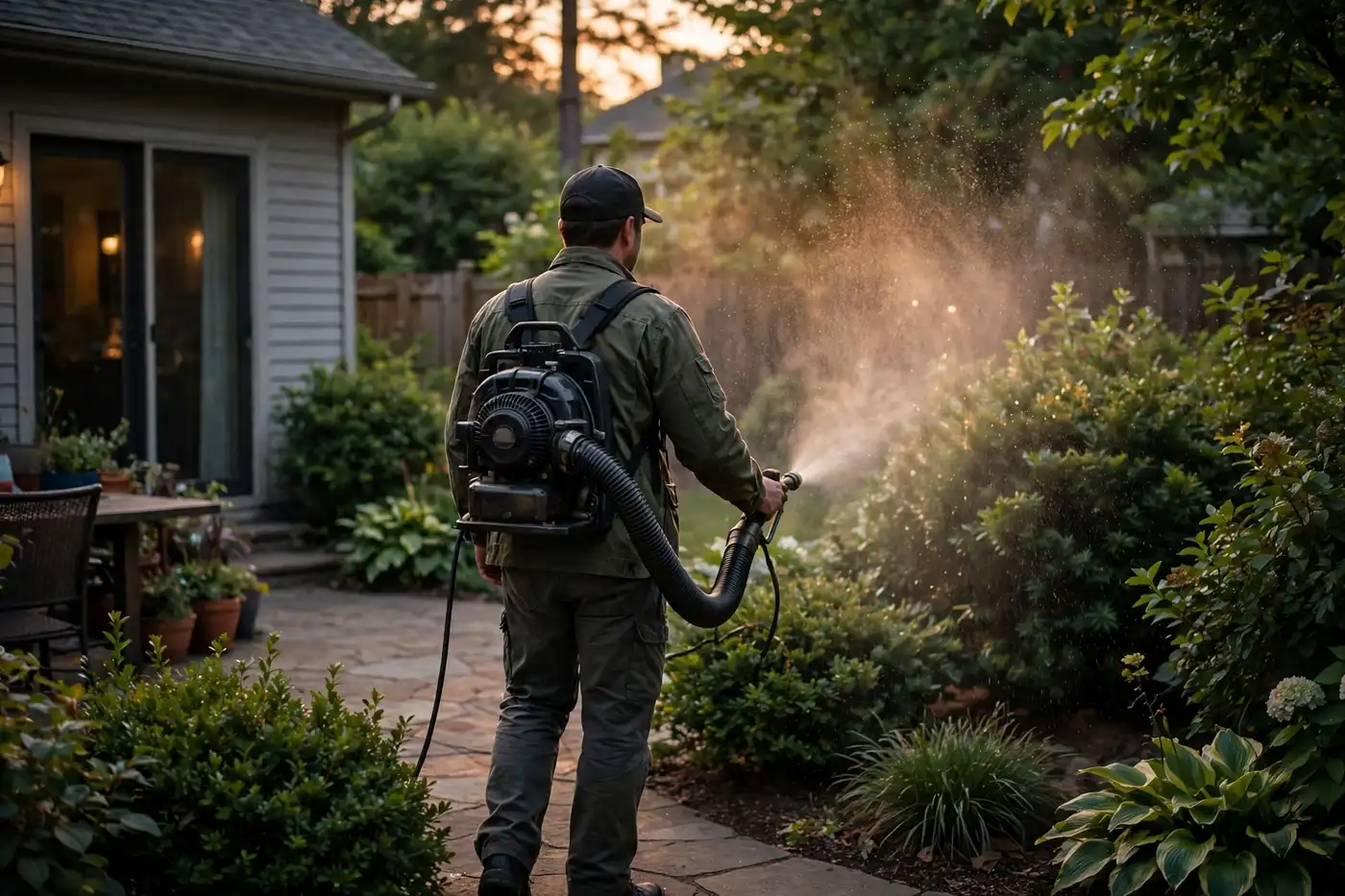
What mosquito control includes
Yard inspection
The visit walks the yard looking for standing water and shaded resting areas — the gutters, the birdbath, the saucer under the pot, the low spot by the fence — and maps them before any treatment.
Breeding source removal list
Every breeding source found is listed for the homeowner: what to drain, what to empty weekly, what to fix so it stops holding water. Removing the water does more than any treatment.
Resting-area treatment
Treatment goes into the shaded vegetation, under decks, and along the wooded yard edge where adult mosquitoes rest during the day — not across the open lawn where they are not.
Yard-edge barrier
The yard edge where lawn meets leaf litter, woodpile or woods is treated as a barrier, so mosquitoes resting there meet the treatment before they reach the patio.
Seasonal timing
The plan is timed to the season: early treatment before the summer peak, and follow-up visits through the humid weeks of July and August when numbers climb.
Follow-up visits
Follow-up visits check whether the yard is holding — whether the breeding sources stayed dry, whether the resting areas are quiet, and whether the plan needs adjusting after a rainy week.
What happens when you call
Describe the yard
On the call, describe the yard — where the mosquitoes are worst, when they bite, and whether there is standing water, a wooded edge, or a low spot that holds rain.
Inspection of water and shade
The visit walks the yard mapping standing water and shaded resting areas, from the gutters to the woodpile, and notes what can be drained and what needs treatment.
Sources listed, treatment placed
Breeding sources are listed for removal, and treatment goes into the resting areas and along the yard edge where mosquitoes actually spend the day.
Seasonal plan set
The plan is set for the season — early treatment, follow-up through the summer peak, and a check after rainy weeks when new breeding sources appear.
Follow-up through summer
Follow-up visits through July and August check whether the yard is holding and whether new standing water has appeared after rain.
How the work is done
Water is the method. A yard with standing water breeds mosquitoes faster than any treatment can remove them, so the visit's first job is the water map: gutters, birdbaths, saucers, tarps, tires, low spots. Draining and removing those sources cuts the population at its origin. Treatment without the water list is a visit that has to be repeated every week.
Treatment goes where mosquitoes rest, not where people sit. Adult mosquitoes spend the day in shaded, humid vegetation — under decks, in dense shrubs, along the wooded yard edge. Treatment placed there reaches them. The open lawn and the patio itself are not where mosquitoes rest, and treating them is mostly treating grass. The visit's yard-edge focus is what makes the treatment last between visits.
Timing follows the season. Early treatment in late spring catches the population before it builds, and follow-up through the humid weeks keeps it down. A single visit in August, when the population is already at its height and the breeding sources are full, cannot do what a seasonal plan does. The plan is set by the calendar, not by the first bad evening.
Before the visit
Clear access to baseboards and the rooms with activity, pick up pet bowls and toys, and note where you have seen activity — the inspection follows your evidence.
Problem → solution
Problem
The patio is unusable after dusk in July. Mosquitoes swarm from the wooded yard edge, and the gutters hold standing water after every rain.
Solution
The visit maps the breeding sources — clogged gutters, a birdbath, a low spot by the fence — and treats the shaded yard edge and the vegetation under the deck. The gutters are listed for cleaning, the birdbath for weekly emptying — and the evenings come back.
Problems mosquito control solves in Worcester
Mosquitoes at dusk on the patio
Mosquitoes that swarm at dusk are resting in the shaded yard edge and the vegetation around the patio during the day. The visit treats those resting areas and lists the standing water feeding them.
Mosquitoes after rain
Rain fills the breeding sources — gutters, saucers, low spots — and the population climbs a week later. The visit checks the yard after rainy weeks and treats the new sources.
Mosquitoes near the wooded edge
A yard that meets woods or leaf litter has a mosquito problem at the edge, not in the middle of the lawn. The visit treats the ecotone where lawn meets woods, where mosquitoes rest and breed.
Mosquitoes around a pond or low spot
Standing water near the house — a pond edge, a drainage swale, a low spot — breeds mosquitoes all season. The visit maps the water and treats the resting vegetation around it.
Other pest services in Worcester
Inspection-led ant control for Worcester homes and businesses.
Inspection-led termite control for Worcester homes and businesses.
Inspection-led spider control for Worcester homes and businesses.
Inspection-led cockroach control for Worcester homes and businesses.
Inspection-led rodent control for Worcester homes and businesses.
Inspection-led flea & tick control for Worcester homes and businesses.
Inspection-led general pest control for Worcester homes and businesses.
Frequently asked questions
Straight answers to the questions Worcester homeowners ask most.
Mosquito season runs from late spring through early fall, with the worst weeks in the humid stretch of July and August. Rainy weeks push numbers up; the plan is timed to the season, not to a single visit.
Standing water — clogged gutters, birdbaths, saucers under pots, tarps, tires, and low spots that hold rain. Even a small amount of still water can hold larvae, which is why the visit maps the water first.
No — treatment goes into the shaded resting areas and along the yard edge where mosquitoes actually spend the day: under decks, in dense shrubs, and where lawn meets woods. The open sunny lawn is rarely the problem.
Empty standing water weekly — birdbaths, saucers, tarps — keep gutters clear, cut back dense vegetation near the patio, and mow so the yard edge does not hold damp shade all day.
Yes — a wooded edge is the most common mosquito source in Worcester yards, and the visit treats that edge as the priority. The yard is treated where it meets the woods, not as if the woods were not there.
Mosquito Control problem in Worcester?
Call now — we will connect you with an independent local provider for an inspection and a clear plan for mosquito control.
Call NowTalk to a local pest control professional
One call connects you with a local professional for Worcester and nearby towns. Describe what you are seeing — where, when, and how often — and the visit is arranged from there.
Mon–Fri 7:00 AM–10:00 PM ET · Sat 8:00 AM–10:00 PM ET · Sun 7:00 AM–9:00 PM ET
Service area
Shrewsbury, MA · Auburn, MA · Millbury, MA · Grafton, MA · Holden, MA · Westborough, MA · Northborough, MA · Leicester, MA · Sutton, MA · Oxford, MA · Boylston, MA · Paxton, MA
Worcester Pest Control Pros is a referral service connecting customers with local pest control professionals; it is not itself the service company.